A jar of raw propolis looks unpromising on the kitchen table. It is dark, sticky and stubborn. Left as it is, most of what people want from it stays locked in the resin. An alcohol extract is how you turn those lumps into something you can actually use, a few drops at a time.
This guide is the practical version: how to prepare a local raw propolis extract at home, with the 10 g jar, food-grade alcohol you can buy in Britain, and a filter that will not wreck the worktop.
If you want the background first — what propolis is, why bees collect it, and how it differs from honey — start with Propolis – Nature’s Protective Gift from the Hive. This page stays on the method.
What you need before you start
ou do not need a lab. You do need the right solvent and a bit of patience.
- One 10 g jar of raw propolis. Use the glass jar it arrives in. There is no need to decant it.
- Food-grade ethyl alcohol between 40% and 80%. Around 80% extracts more of the resins. Weaker spirit still works; it just takes longer and pulls less.
- A kitchen scale, if you are diluting 95% spirit down to 80%.
- A fine strainer plus a coffee filter, or plain unscented kitchen paper folded a few times.
- A dark glass bottle for the finished extract, or the original jar once it is clean and dry.
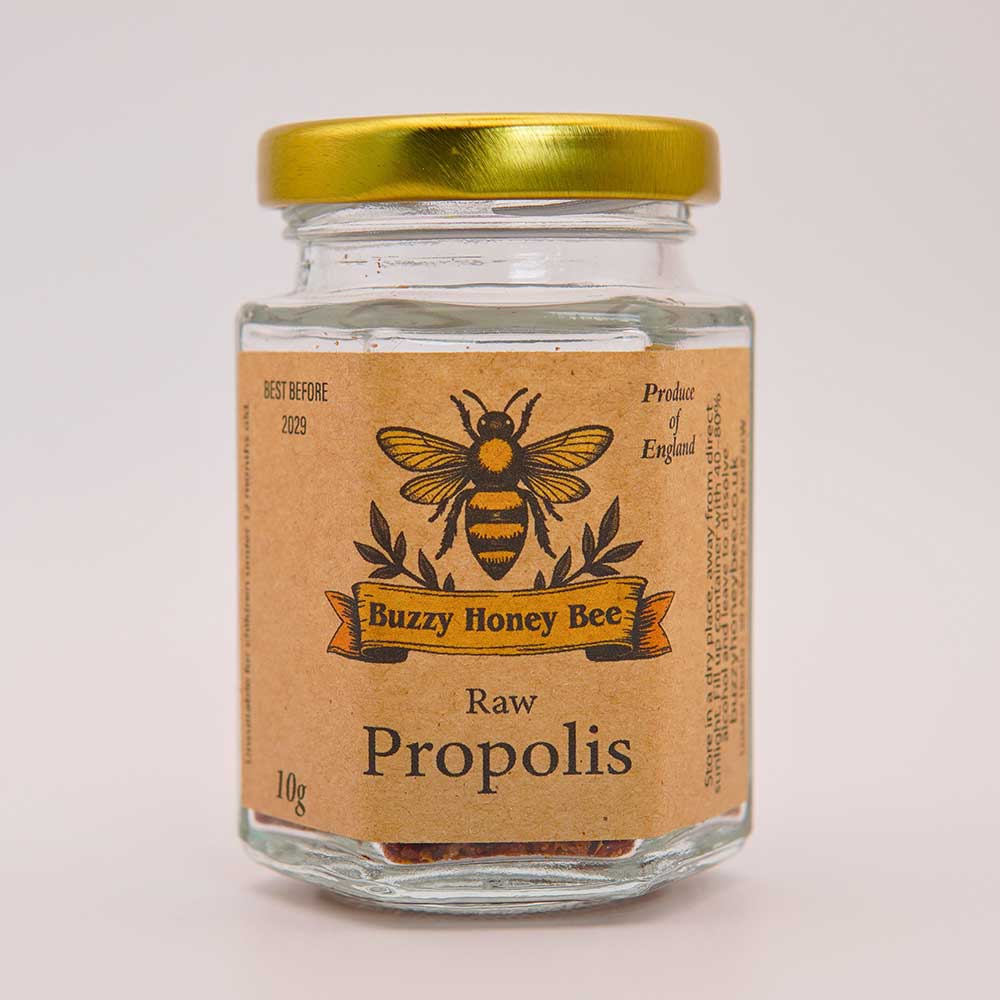
If you have not bought the propolis yet, the jar this method is written for is Local Raw Propolis 10 g from the shop. It is unprocessed resin from our own apiaries, ready to fill with alcohol.
£5.00Add to basket
Which alcohol to use in the UK
The solvent has to be food-grade ethanol. Surgical spirit, methylated spirit and anything denatured for cleaning are not for this job. They are not made to be taken by mouth.
In Britain the straightforward source is Spirytus Rektyfikowany from a Polish shop: 95% food-grade ethanol. Ordinary vodka sits around 37.5–40%. It will extract some of the resins, but it is a weaker pull and a slower one.
For a 10 g jar you want enough liquid to cover the propolis completely. That is usually about 90 g of 80% alcohol, which gives a roughly 10% extract by weight.
How to dilute 95% Spirytus to 80%
Work by weight, not by guesswork.
- Pour 15 g of boiled, cooled water into the jar with the propolis.
- Add 75 g of 95% Spirytus.
- That makes 90 g of alcohol at about 80%. Seal the jar tightly so the spirit cannot evaporate.
If you already have 80% food-grade ethanol, skip the water and fill the jar with that instead.
Preparing your local raw propolis extract
Leave the propolis in its own jar. Fill it, cap it, and put it somewhere dark and cool, out of direct sun.
Shake it gently every morning and evening. You are not trying to smash the lumps. You are keeping fresh alcohol in contact with the surface of the resin.
Large pieces can take several weeks. Some batches need a couple of months. That is normal. Propolis is a mix of plant resins, wax and odds from the hive. The alcohol dissolves the resins. The wax does not vanish. It will show up later as sediment.
How to speed up the process
If you want a shorter wait, freeze the jar of propolis for a day before you add the alcohol.
Frozen propolis turns brittle. Tip it out and crush it with a wooden stick, the back of a spoon or the spine of a knife into small pieces or a coarse powder. Fine bits give the alcohol more surface to work on, so the extract darkens sooner.
Work quickly once it leaves the freezer. As it warms it turns sticky again. If it starts to gum up, put it back in the cold for half an hour and carry on.
Protect the worktop. Propolis stains. Cover the table with foil, old newspaper or a cloth you do not mind losing before you crush or filter anything.
How to know when the propolis has dissolved
Swirl the jar. You should not see hard lumps rolling around the bottom. The liquid looks even, usually a deep amber to brown. After a few minutes of standing, a fine, pale sediment settles. That sediment is mostly wax and insoluble bits. It is not a failed batch.
If chunks are still sitting there after many weeks, crush what is left and give it more time. Do not heat the jar on the hob to hurry it. Heat is a poor friend of this extract.
How to filter your local raw propolis extract
Line a fine strainer with a coffee filter or with unscented, uncoloured kitchen paper folded a few times so it does not tear. Set the strainer over a clean bottle or jug.
Pour slowly, sediment and all. Let it drip. Do not press or stir the filter. Pressure pushes wax through and clouds the extract.
What you want in the bottle is a clear or gently cloudy dark liquid. A little haze is fine. Mud is not.
How to store the finished extract
You can pour it back into the original jar if that jar is clean. A small dark glass bottle with a tight cap is better for daily use.
Keep it in a cupboard or in the fridge, away from light and heat. Label it with the date and the ratio you used. An alcohol extract stored like this keeps for a long time. The spirit is doing most of the preserving.
10% or 30% — what the numbers mean
Fill one 10 g jar with about 90 g of alcohol and you have a roughly 10% extract. That is the batch this page is written around.
A stronger jar needs more propolis, not hotter alcohol. Three 10 g jars with 70 g of alcohol between them is the 30% version. It is thicker, darker and more of a faff to filter. Start with 10% unless you already know you want the stronger one.
| Extract | Propolis | Alcohol (about 80%) |
|---|---|---|
| About 10% | One 10 g jar | 90 g, jar filled |
| About 30% | Three 10 g jars (30 g) | 70 g |
These figures are kitchen ratios, not laboratory assays. Home extracts vary with the size of the pieces and how long you leave them.
A short word on using it
People take a finished extract as drops, or dab a little on unbroken skin after a test patch. It contains a high level of alcohol. It can sting. It can stain cloth and worktops. It is not a medicine, and this page is not a dosage chart.
Do not give it to children. Do not use it if you react to bee products. Anyone who cannot have alcohol should not take an ethanol extract.
A separate guide on everyday use will sit beside this one when it is ready. Until then, treat the bottle as a strong kitchen extract, not as a treatment.
Frequently asked questions
Can I prepare a local raw propolis extract with vodka?
Yes, if it is a plain food-grade vodka and you accept a slower, lighter extraction. 40% alcohol dissolves less of the resin than 80%. Give it longer, shake it daily, and do not expect the same depth of colour.
Is surgical spirit or methylated spirit all right?
No. Those products are denatured. They are not food. Use only food-grade ethyl alcohol.
How long does it take?
Anything from a few weeks to a few months. Crushed, frozen propolis in 80% alcohol is at the short end. Large lumps in 40% vodka sit at the long end.
Why is there sediment in the jar?
Wax and hive debris do not dissolve in ethanol. Fine sediment after standing is expected. Filter without pressing and leave the last gritty spoonful behind if you want a clearer bottle.
Why is my extract cloudy?
Usually because the filter was squeezed, or because the mix was still warm. Let it settle in the fridge and decant the clearer liquid off the top, or run it through a fresh coffee filter once, slowly.
Can I make a stronger extract than 10%?
Yes. Use more propolis for the same volume of alcohol, up to about 30%. Stronger than that extracts less efficiently and is harder to filter. Three 10 g jars to 70 g of alcohol is the upper ratio on this page.
Does the finished extract need the fridge?
Cool and dark is enough. The fridge is fine if the cupboard is warm. Keep the cap tight so the alcohol cannot creep off.
Can I use glycerine instead of alcohol?
Glycerine pulls far less of the resins and needs much longer. This method is the ethanol version, because that is what the 10 g jar is sold for. An alcohol-free extract is a different recipe.
Is a homemade extract the same as a shop tincture?
It is the same idea: resin in food-grade alcohol, then filtered. Strength, clarity and alcohol percentage vary from kitchen to kitchen. A shop bottle is standardised. Yours will reflect the batch in the jar.
Where does the propolis in the 10 g jar come from?
From our own apiaries. It is collected as raw resin, not imported powder. The wider story of the hives sits in Propolis – Nature’s Protective Gift from the Hive.
What to do next
If the jar is still on the shelf, fill it, date the lid and start the shakes. If you do not have propolis yet, the 10 g jar is the one this method is built around.
The same Bee Treasures shelf also holds Local Bee Pollen 70 g if you want another hive product that does not need a two-month wait.
Enjoyed this article? If you’d like to support more honest writing about bees and local honey, you can buy me a coffee here:
Buy Me a Coffee – Buzzy Honey Bee
Your support also helps me continue working with the bees and offering free bee swarm collection.
Of course, the best way to support this small apiary is still by choosing one of the products below.