
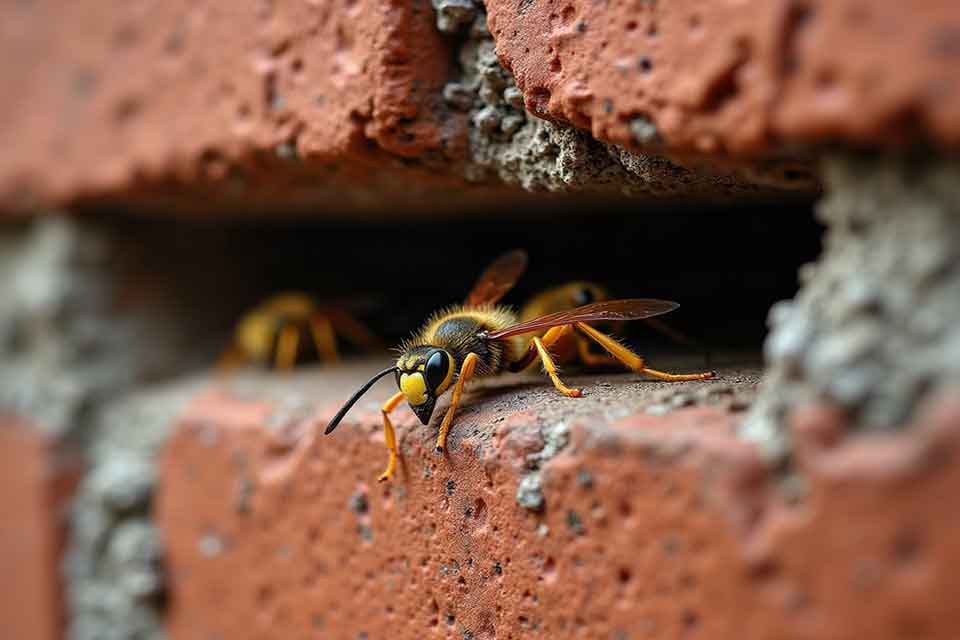
You do not see a grey paper ball. You see wasps leaving the brick. They use the same small hole, over and over: a gap in the mortar, the holes in an air brick, the crack where a pipe enters the wall. From the garden it looks as if the house itself is the nest.
It is not. In a typical British wall there is a cavity between the outer brick and the inner leaf. That void is dry, sheltered and easy to miss. A queen that finds a way in will build there. The paper stays hidden. The traffic does not.
This guide is about that call: wasps coming out of the wall, what a cavity nest actually is, why blocking the hole makes it worse, and what is worth doing now rather than hoping the first cold night will finish it.
Wasps coming out of the wall: the short answer
- A steady stream of wasps using one hole in the brickwork is a nest, not a few insects passing by.
- In most UK houses that hole leads into the cavity, not into a nest glued on the face of the wall.
- You will often never see the paper. The entrance is the evidence.
- Do not block an active hole. Do not pull the air brick off. Do not spray into the gap “to see”.
- If the flight line is next to a door, a path or a window you use, have it dealt with while the nest is live. A quiet wall in November is a different job.
The useful question is not “where is the nest?” It is “which hole are they using, and is anyone walking through that line?”
What a cavity wall nest actually is
A cavity wall is two skins with a gap between them. Older houses leave that gap empty. Newer ones pack it with insulation. Either way it is a dark, dry space with a small outside entrance — which is exactly what a queen is looking for in spring.
She does not need a soffit or a loft hatch. A missing dab of mortar is enough. So is a clay air brick with open holes. So is the slot around a boiler flue or a tap pipe. Once she is in, the nest grows through summer the way any other wasp nest grows. By August it can be large, and the only sign from the pavement is traffic at one point on the wall.
Wasps chew weathered wood and mix it with saliva to make paper. In a cavity they also chew at insulation if it is in the way. That is messy. It is not the house falling down. Brick and block stay put. The problem is the sting line at the hole, and the risk that a blocked entrance pushes wasps through plasterboard into the room.
That is why this job feels different from a nest under a shed roof. You cannot see the envelope. You can only see the commute.
How to tell the nest is in the wall
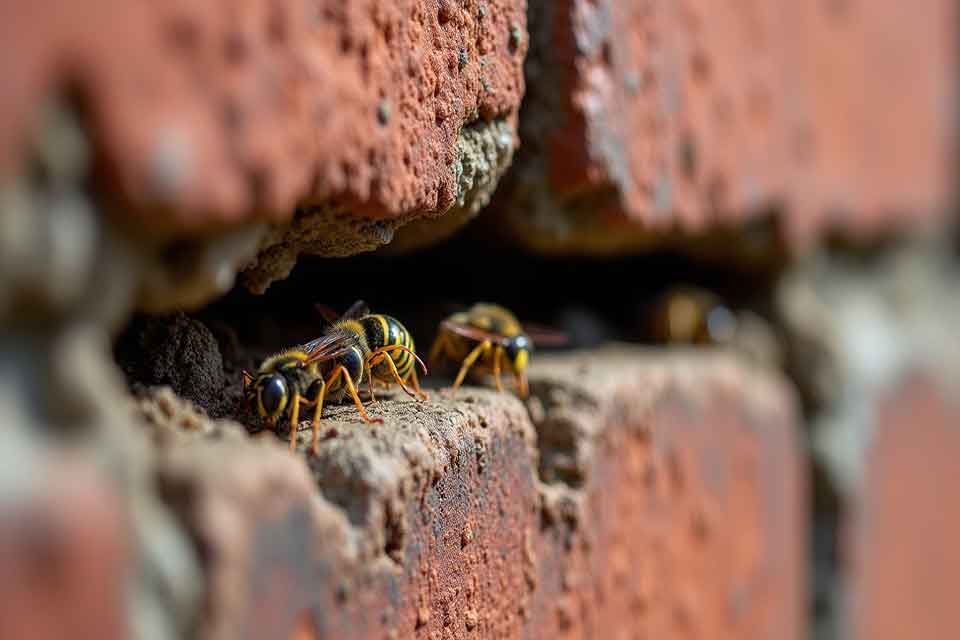
Watch from the ground, not from the hole.
On a mild afternoon, wasps using a cavity nest fly a straight line to one gap and disappear. They come back out of the same gap. That two-way traffic is the nest. Random wasps on the sunny brick, with no hole in common, are usually hunting or passing through.
Other clues, if you already have the traffic:
- A low, local buzz or scratch behind one stretch of wall on a warm day.
- Wasps appearing in the same room with the windows shut, often near a light, a vent or the top of a skirting board.
- An air brick that looks ordinary until you stand back and count the insects using two or three of its holes.
A photograph from a few metres away is enough for someone who sees these walls every week to say whether that traffic is a nest. It is not a reason to stand in the flight line or to start opening the wall.
Masonry bees confuse the picture in spring and early summer. They are smaller, often gingery, and they use many separate mortar holes rather than one busy entrance. Honey bees can occupy a cavity too, but the cluster and the sound are different, and that is a different job. If the insects are smooth, bright yellow-and-black, and they stream in and out of one hole in July, August or September, you are looking at wasps.
Why they use air bricks and mortar gaps
An air brick exists to let the wall or the floor void breathe. The holes are the right size for a wasp and the wrong size for most of what a householder notices until August. Mortar gaps do the same job with less honesty. A perished joint, a weep hole, a poorly pointed repair, any of those is a door. South-facing walls warm up early. That is why the same elevation can show traffic two summers running even though last year’s paper is dead. None of this means the old nest switched itself back on. The cavity stayed open. That distinction is the subject of do wasp nests come back next year. This page is only about the wall in front of you this season.
Late summer makes the entrance harder to live with. The colony is large, the workers want sugar, and the hole is defended more sharply. Why that shift happens at drinks and bins is covered in why wasps sting more in late summer. A cavity nest is the same biology in a worse place: you cannot walk around it if it sits by the back door.
What not to do when wasps are coming out of the wall
Do not block the hole while it is busy. Closing a live entrance does not kill the nest. It sends the colony looking for another way out. That way is often a socket, a light fitting, or the gap above the skirting on the inside of the same wall.
Do not prise off the air brick to “have a look”. You will be standing in the flight line with the nest behind you.
Do not empty a supermarket spray into the gap. Liquid sits at the mouth of the hole. It does not reliably reach a nest sitting sideways in the cavity. It does reliably make the entrance angry.
Do not open the wall from inside to find the paper. That is how a hidden nest becomes a room full of wasps.
If you need the nest dealt with, leave the entrance open and stay out of the line. A photo from the path is the start of that job, not a test you run with a ladder.
If wasps are already coming into the room
That usually means they have found a second exit: a crack in the plaster, a poorly sealed light, a loft hatch that shares the same void. It does not always mean the nest has moved. It means the cavity now connects to the living space.
Close the internal door to that room if you can do it without standing at the hole. Do not seal the outside entrance. Do not start pulling plasterboard.
Wasps at a window that has been open all afternoon are a different problem. Those came in from the garden. Wasps at the same ceiling corner with the window shut are the wall.
After the traffic stops
The paper in the cavity will not restart next April. The hole might still be there. Once you know the nest is finished — not because one cold morning looked quiet, but because the entrance has stayed dead through mild days — the useful work is the gap. Mesh on an air brick that still needs to ventilate. Mortar in a joint that should never have been a door. A plate around a pipe.
Seal a live hole and you push wasps indoors. Seal a dead hole, and you make the wall less interesting to the next queen. That is ordinary maintenance, not a second treatment.
What to do this week
If the hole is busy:
- Keep people and pets out of the flight line.
- Leave the entrance open.
- Do not spray, block or open the wall.
- If that line crosses a door, a path or a window you use, have the nest checked and dealt with. A photo from the ground helps someone see the hole before they arrive. It is not a reason to start the job yourself.
If the hole looks quiet:
- Do not treat a quiet afternoon as proof.
- Do not pull the paper out of the cavity to find out.
- Once you know the nest is finished, fix the air brick or the joint.
Frequently asked questions
Why are wasps coming out of my wall?
Because a nest is using the cavity behind the brick. The paper is inside. The hole you can see is the entrance.
Is the nest in the air brick?
Almost never. The air brick is the door. The nest sits in the void behind it.
Can wasps eat through the wall?
They do not eat brick. They can chew insulation and, if they are trapped, plasterboard. That is why blocking a live hole is a bad idea.
Should I block the hole tonight?
No. Not while there is traffic.
Will the nest ruin the house?
The usual damage is mess in the cavity and stings at the entrance, not a collapsed wall. The urgent problem is the flight line, not the brickwork.
Could it be bees?
Masonry bees use many small mortar holes and look different. A hanging fuzzy cluster on a fence is a honey bee swarm, which is collected, not treated. One busy hole in the brick with smooth yellow-and-black insects is a wasp nest.
Do I need to open the wall to get the nest out?
No. Finding the paper is not the first job. Dealing with a live entrance from outside is.
Will wasps use the same wall next year?
Not the old paper. They may use the same hole if it is still open. Seal it after the colony has finished.