
If a wasp has just gone into a pint in West Bridgford, or a yellow-and-black stream is vanishing into the soffit, you are not imagining the change. Late summer is when wasps sting more often, and when they turn up on drinks, bins, fallen fruit and, if you keep bees, at the hive entrance. It is not a sudden change of character. Social wasps in Britain live one season. By August the colony is at its largest, the workers have lost their usual sugar supply inside the nest, and they start looking for it on our tables instead. At the same time the last brood includes next year’s queens, so the entrance is defended more sharply.
This guide explains that shift: why wasps sting more in late summer, why the “drunk wasp” story is mostly wrong, how to tell a wasp from a honey bee, and what actually makes a nest dangerous. If you already know you have an active wasp nest around Nottingham, there is a separate page for wasp nest removal in Nottingham. If the insects are hanging in a calm, fuzzy cluster, start with free honey bee swarm collection instead.
Why late-summer wasps feel different
Through June and July most people barely notice common wasps. The workers are hunting aphids, caterpillars and other insects. They chew that protein and feed it to the larvae. The larvae pay them back with a sugary secretion. Adult wasps live on that sugar. You are not interesting to them, because you are not protein and you are not their nest.
Then the queen switches. She stops producing worker larvae and starts producing males and the next year’s queens. The ratio of hungry mouths to idle workers flips. Researchers at University College London have described those late-season workers as effectively furloughed: still alive, still needing energy, no longer paid in larval sugar. That is when they start touring beer gardens and kitchen windows. There are more wasps on the wing. They are competing for sugar. And the paper nest is bigger than it has been all year, so vibration near the entrance is treated as a threat.
This is why wasps sting more in August and September than they do in June. The insect has not changed personality. The colony has changed job.
The colony in one season
Social wasps in Britain, mainly the common wasp (Vespula vulgaris) and the German wasp (Vespula germanica), do not overwinter as a working nest. A single queen comes out of hibernation in spring and starts a small paper nest. By late summer that nest can hold hundreds, sometimes thousands, of workers. The paper is chewed wood mixed with saliva. You may never see the grey ball itself. What you see is traffic: a steady two-way stream at one gap in the fascia, an airbrick, a shed vent or a hole in the ground. A nest that size is not a handful of insects. Disturb the entrance and you are dealing with a colony that can recruit. That is the practical difference between one wasp on a bun and a nest in the eaves.
The sugar switch — not a bad mood
Early-summer wasps are protein hunters. Late-summer wasps are sugar hunters. The picnic, the fallen plums, the sticky bin lid and the open can of drink are simply the nearest calories. They are also more visible because they are foraging in the same places we sit. A worker in July was in the hedge. A worker in September is on the table. More meetings mean more swats. More swats mean more stings. That loop is most of what people mean by “aggressive wasps”.
The “drunk wasp” story
You will hear that late-summer wasps are drunk on fermenting fruit. Fallen apples and plums do attract them, and fermented juice can make an individual clumsy. It is a poor explanation for the whole season. What looks like tipsy staggering is more often nutritional stress and competition. The fruit is sugar. The picnic is sugar. Swatting at that wasp does not sober it up. It reads as an attack on a scarce resource, and that is when people get stung. Cover the food, put a lid on the glass, walk away. Do not flail.
Why wasps sting
A wasp stings to defend itself or the nest. It does not need a special month to do it. A queen in May, a worker in July and a hungry forager in September can all sting if you trap them, crush them or stand in the entrance. Late summer is simply when it happens more often. The nest is bigger. More wasps are on the wing. They are on drinks, fruit and bins, so they meet people more. None of that means a nest in June is harmless.
Wasps can sting more than once. The sting is smooth, not barbed like a honey bee’s, so the insect does not die. That is why a disturbed nest is a poor experiment. You are not dealing with one defender.
What actually triggers a defensive sting
- Standing in the entrance flight path — eaves, soffit gap, airbrick, shed vent.
- Vibration: mowing against the fence the nest is built on, hammering, loft boards, a football against the wall.
- Blocking the hole. Trapped wasps look for another way out, often into the room.
- Swatting. One crushed wasp can release alarm scent. Others follow.
- Breath and dark colours close to the nest. Not a myth worth testing at arm’s length.
One wasp in the kitchen is usually a scout or a thirsty worker. Late-season foragers travel. A steady two-way stream at the same hole, all afternoon, is a nest.
Why wasps sting more around food, bins and hives
Three things pile up in August and September.
- First, numbers. Peak colony size means more foragers and more guards.
- Second, diet. With larval sugar gone, human food becomes a foraging target. That is why late-summer wasps feel as if they are “after you”. They are after the drink.
- Third, defence of the last brood. The nest still holds next year’s queens. Workers treat vibration at the entrance as a threat to that brood, not as a person walking past with a hosepipe.
- There is a fourth thing if you keep honey bees, or if you live near someone who does. Late-summer wasps raid hives. They slip through the entrance, kill honey bees, rob stores and leave chewed brood and dead workers on the landing board. A strong colony can usually defend itself. A small or newly housed swarm cannot.
That is the view from the apiaries around Woodborough, Bingham, Whatton, Wysall, Strelley and Oakwood — the same villages behind the jars on where the honey comes from. Early-summer workers do hunt other insects. That does not make a nest in the soffit, over a path, or next to a hive a garden feature. At the doorway and at the hive they are a pest.
If you want to help pollinators, plant for honey bees and wild bees. Start with the best plants for bees. Do not protect an active wasp nest because a general wildlife article told you to live and let live.
Wasp, honey bee or bumblebee?
Most “bee” calls in August are not honey bees. Getting that wrong is how a swarm gets sprayed and a wasp nest gets poked with a stick.
A hanging, rugby-ball cluster of fuzzy brown-orange insects is almost always a honey bee swarm. Those bees are collected free of charge. See honey bee removal in Nottingham and Derby and the longer free swarm collection guide.
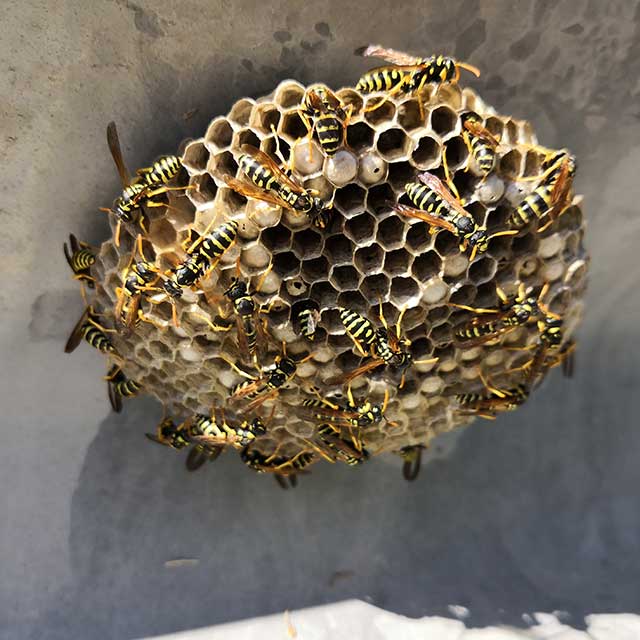
A grey paper nest, or a constant stream of smooth, bright yellow-and-black insects in and out of one hole, is a wasp nest. Large, round, very furry insects going slowly in and out of a compost heap or a hole in the ground are usually bumblebees. Leave those. They are gentle, annual, and they do not need treating.
| Clue | Honey bee | Wasp | Bumblebee |
|---|---|---|---|
| Look | Fuzzy, golden-brown | Smooth, bright yellow and black | Very furry, round |
| Typical sight | Hanging cluster, or traffic into a cavity | Paper nest, or busy hole in eaves / wall | Slow traffic into soil, compost, bird box |
| Late-summer mood | Swarm is usually calm | More defensive at the nest; foragers at food | Still gentle if left alone |
| What to do | Call a beekeeper — collection is free here | Do not poke it; have an active house nest dealt with | Leave them |
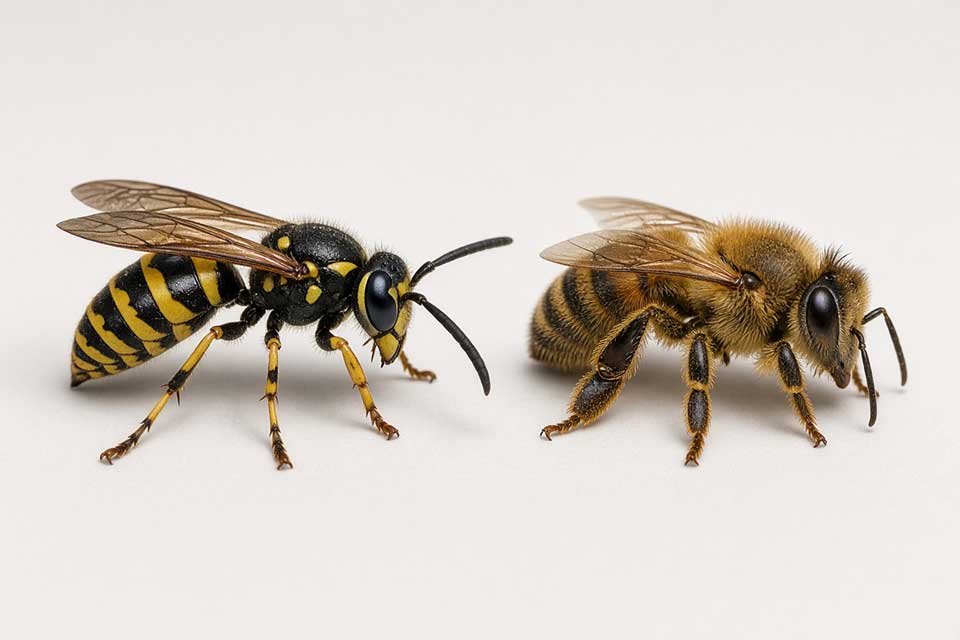
A large dark insect with yellow leg-tips is not a common wasp. That is the description used for the yellow-legged (Asian) hornet, which should be reported to the National Bee Unit, not treated as a private garden job. A native European hornet is chestnut and gold, and usually calmer than a common wasp. If you are not sure what you are looking at — wasp, honey bee, bumblebee or hornet? Contact a local beekeeper.
Wasp nests in lofts, eaves and wall voids
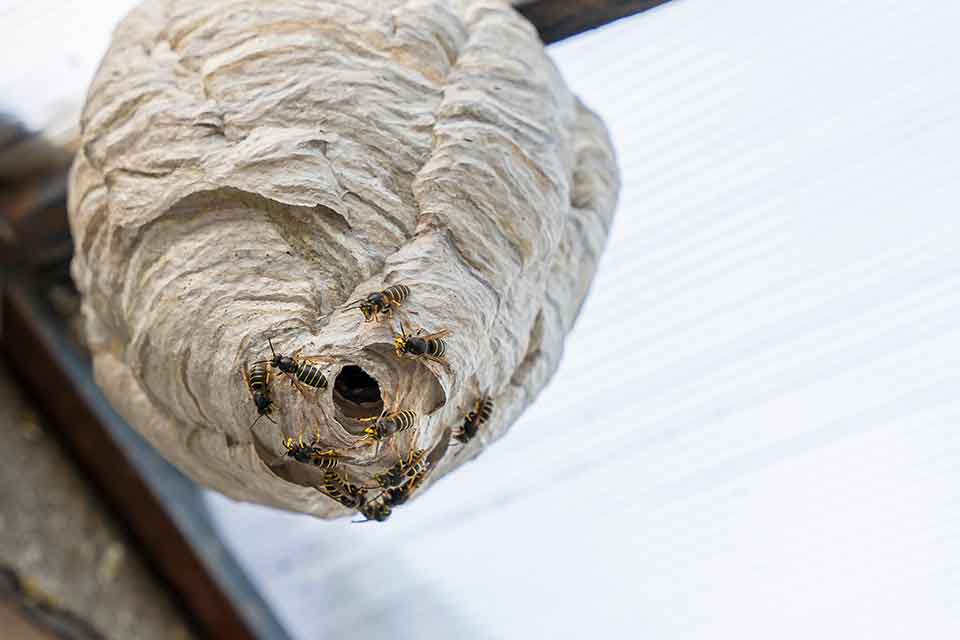
A loft nest is the call that follows “they’re in the roof”. You rarely see the paper. You see traffic at one gap in the fascia, or the odd wasp dropping into the landing when the hatch is opened. Wasps use cavities because they are dry, sheltered and close to foraging. Soffits, wall voids, shed roofs and loft insulation all work. The entrance can be a gap you would not notice until August, when the traffic is too heavy to miss. If the wasps are coming out of the brick itself — a mortar gap or an air brick — that is a cavity wall nest; that version is why wasps are coming out of the wall.
Two mistakes make a loft nest worse.
The first is going up with a torch and a can of spray. Disturbed workers look for another way out. That way is often a bedroom light fitting or the hatch you just opened.
The second is stuffing the outside hole with steel wool, expanding foam or a cloth while the colony is active. Blocking the flight line does not kill the nest. It pushes it indoors.
Watch the outside from the ground. A ten-second clip of the hole is usually enough to say wasp, honey bee or something else. If the traffic is active and people are using the house, the nest needs dealing with — not watching until the heating goes on.
What not to do if you find a wasp nest
You do not need a plan for the whole summer. You need the next ten minutes not to turn a nest into a room full of wasps.
- Do not stand in the flight line. Get people and pets away from it. Close the nearest windows. Open them again on the other side of the house if you need air.
- Do not swat at foragers on food. Cover the plate. Put a lid on the glass.
- Do not block the hole.
- Do not spray the entrance in daylight and stand there to watch. Disturbed foragers come home angry.
- Do not knock the nest down with a broom. Wasps can sting more than once; the colony can recruit.
An active wasp nest at a door, loft, eaves, shed, play space or path is a sting risk. Waiting for October while children use the back door is how people get stung more than once. Common wasp nests on private property are not protected in the way some birds and bats are, but DIY spraying, boiling water and blocked holes are still how indoor infestations start.
From a safe distance, a photo or a short video of the insect, the nest if you can see it, and the hole they use is usually enough to tell a wasp from a honey bee. If you are not sure what you are looking at, send the picture to a local beekeeper before anyone sprays. Around Nottingham, honey bee swarms are collected free; an active wasp nest is covered on the wasp nest removal in Nottingham page.
If you have already been stung
A single sting on the skin is painful and usually settles. Follow the NHS page on insect bites and stings, not a home remedy from a neighbour.
Wash the area with soap and water. Use a cold compress wrapped in a cloth. Painkillers such as paracetamol or ibuprofen can help. Do not scratch. Wasps do not leave a barbed sting in the skin the way a honey bee often does, so there is usually nothing to scrape out. A sting inside the mouth or throat is different. It often happens when a wasp has gone into a can, bottle or pint and nobody saw it. The danger is not the pain. It is swelling. The tongue, soft palate or throat can swell quickly and start to block the airway. Do not wait to see if it “settles”.
If you have been stung in the mouth or throat, call 999. Say it was a wasp, that the sting is in the mouth or throat, and whether swallowing or breathing already feels tight. If breathing is difficult, the face or throat is swelling, or the person feels dizzy or faint, that is an emergency.
Several stings, or a sting near the eyes, also need a lower threshold for advice. Keep the story simple when you call: it was a wasp, this is where, this is how the person is now. Once the person is safe, the nest is still there. Treating the sting and leaving the colony in the soffit is how the next sting happens.
A simple year in the wasp nest
The calendar explains a lot of bad timing. People spray a dead nest in November. People also ignore a doorway nest in August because “they’ll go soon”. Both miss the point. Peak sting season is August and September, when the colony is largest and the workers are on sugar.
| Season | What is happening |
|---|---|
| Apr–May | Queens out of hibernation. Tiny starter nests. Easy to miss, still worth identifying if they are at the house. |
| Jun–Jul | Workers hunting insects. You may not notice them until traffic builds at one hole. |
| Aug–mid Sep | Peak size. Sugar hunting. Most stings. The window when a house nest is most worth dealing with. |
| Late Sep–Oct | Colony breaking down. Still capable of stinging at the entrance. New queens leaving to hibernate. |
| Nov–Mar | Old nest empty. It will not be reused. Proof gaps after the colony is gone if you want fewer queens next spring. |
An empty paper ball in winter is not an active colony. The workers, males and old queen die as the nights cool. New queens leave before that, mate and hibernate somewhere else. They do not move back into last year’s nest. That is useful to know. It is not a reason to leave a live nest over a door in September.
Frequently asked questions
Why do wasps sting more in August and September?
The colony is at its largest, the workers have lost their larval sugar supply, and they start foraging on human food and drink. Defence at the nest is also sharper because the last brood includes next year’s queens. That is why wasps sting more in late summer than in early summer.
Are late-summer wasps drunk?
Not in the way the story is usually told. Fermenting fruit can disorient an individual. The seasonal change is hunger, unemployment inside the nest, and more wasps in the same gardens as our puddings.
Will a wasp nest go away on its own?
The colony dies as the weather cools, and the paper nest is not reused next year. That does not make an active nest over a door, in a loft or next to children safe in August and September. Those weeks are when most stings happen.
Should I remove a wasp nest myself?
If you are asking the internet, the answer is almost always no. Daytime sprays at an active entrance, boiling water and blocked holes are how indoor infestations start. Identify the insect first.
How do I tell a wasp nest from a honey bee swarm?
A swarm is a hanging cluster of fuzzy bees. A wasp nest is paper, or a busy hole with smooth yellow-and-black insects. When it is unclear, use the swarm guide and the honey bee removal page, or send a picture.
Do wasps die when they sting?
No. A honey bee often does, because the sting is barbed. A wasp can sting again.
Is it illegal to destroy a wasp nest in the UK?
Common wasp nests on private property are not protected in the way some birds and bats are. That does not make blanket destruction a good idea, and it does not make DIY spraying a good idea. Keep the honey bees. Leave the bumblebees. Deal with an active wasp nest that is a risk at the house.
Are wasps useful in the garden?
Early-summer workers hunt other insects. That is not a reason to keep a nest in the soffit, over a path, or next to an apiary. Late-summer wasps raid honey bee hives, defend the paper nest, and turn up on food and drink.
Why do wasps go into beehives in late summer?
They are after stores. Once the larval sugar inside their own nest dries up, a hive looks like a concentrated food source. They kill honey bees on the way in. That is one reason beekeepers treat late-summer wasps as a pest rather than a pollinator story.
The short version
Wasps sting more in late summer because the colony is at peak size, the workers have lost their sugar supply inside the nest, and they start taking it from drinks, fruit, bins and hives. They can sting more than once. The entrance of a large nest is defended more sharply than it was in June.
Cover the food. Do not block the hole. Do not spray and wait. Decide first whether you are looking at a honey bee swarm, a bumblebee nest or wasps. Keep the bees. Leave the bumblebees. Have an active wasp nest at the house dealt with rather than waited out.
If you came here from a jar and you now have a nest as well, the nest comes first. The Bee Knowledge Hub and the shop will still be there when the flight line is quiet — what local honey actually means is a better next read than another search for home remedies.
Around Nottingham, a photo on WhatsApp to 07845 755733 is enough to separate a free swarm collection from a quoted wasp job. The service detail is here: wasp nest removal in Nottingham.
Further reading
- NHS — Insect bites and stings: nhs.uk/conditions/insect-bites-and-stings
- National Bee Unit — yellow-legged (Asian) hornet: nationalbeeunit.com
- University College London / Prof. Seirian Sumner — late-season worker wasps described as effectively furloughed once larval sugar stops