
That grey paper ball in the soffit looks permanent. By late September the traffic has dropped, the evenings are colder, and the advice is always the same: leave it, wasps don’t come back to an old nest. The first half of that sentence is true. The second half is where the confusion starts. Do wasp nests come back next year? The paper nest itself does not. The gap it used often does. Those are two different things, and mixing them up is how an empty November loft turns into another busy entrance the following May.
This guide is about that distinction: what happens to a British wasp nest when the season ends, why the same soffit can look occupied again in spring, and what is worth doing now rather than waiting for frost.
Do wasp nests come back next year? The short answer
- No. British social wasp colonies last one season. The workers, males, and old queen die as the nights cool.
- New queens leave before that, mate, and hibernate somewhere else — in soil, under bark, in a shed, not inside last year’s paper ball.
- They do not move back into the old nest. That part of the folklore is right.
- They do look for a dry cavity in spring. The same soffit gap, fascia joint or air brick is still a good address.
- An empty nest in November is not a reason to have left a live one in August.
The useful question is not “will this nest restart?” It is “will a new queen find the same hole next April?” Those are different jobs.
Why this question spikes in late summer
August and September are when wasp nests are largest and most obvious. That is also when people hope winter will empty the cavity for them. Wasps are sharper at the entrance in those weeks, and more interested in drinks and bins. That shift is covered in why wasps sting more in late summer. What follows here is the next part of the year: the nest after the peak, and the hole it leaves behind.
Hoping frost will finish the job is understandable. The biology helps a little. It does not make a busy entrance over the kitchen door safe for the next six weeks. The pattern is the same most years. Traffic at the eaves builds through July. By late summer the nest is difficult to ignore. Then the first cold night arrives, and the question becomes whether it is worth waiting. Watching a dying colony from a distance is one situation. Children still using that door twice a day is another.
What actually happens to a wasp nest at the end of summer
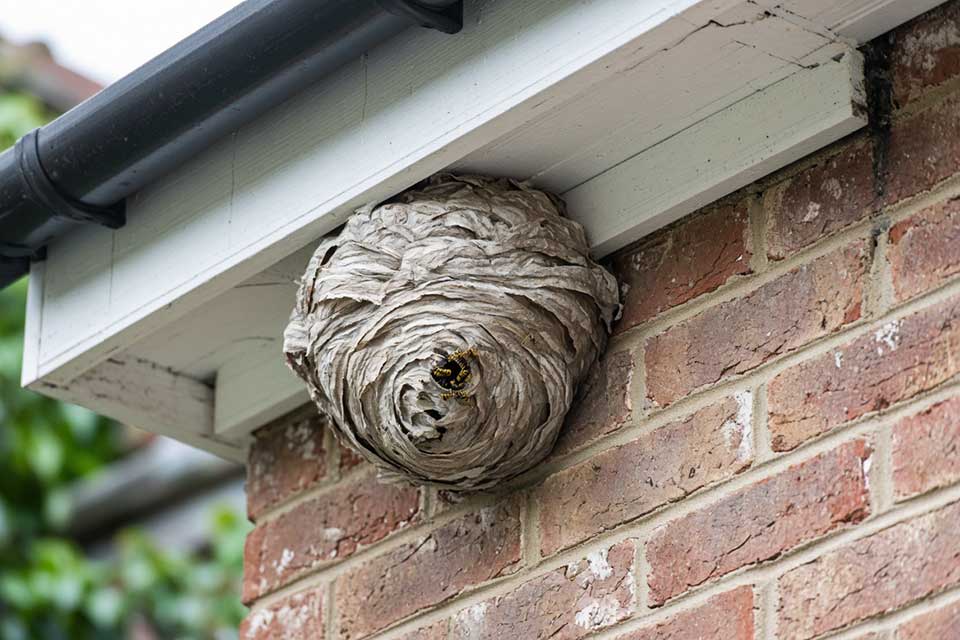
Common wasps and German wasps in Britain are annual. One queen starts a small paper nest in spring, built from chewed wood mixed with saliva. Through summer the workforce grows. By late August that nest can hold hundreds of workers, sometimes more. Then the job of the colony changes. The queen produces males and the next year’s queens. Workers that spent June hunting insects now hunt sugar. The entrance is defended more sharply because the last brood is the future of the line. As nights lengthen, the colony runs down. Workers die. The old queen dies. The new queens leave, mate and look for a winter site. What you are left with is a grey paper structure and a hole in the building. That paper is not a house that gets locked and reopened in April. It is last year’s work. Damp, mites and decay take it apart if you leave it. Wasps do not treat it as a reusable home.
The nest dies. The address does not.
This is the distinction most garden advice blurs. A queen coming out of hibernation in April is looking for a dry, sheltered cavity with a small entrance she can defend. She is not looking for last year’s comb. She is looking for last year’s kind of gap.
If the soffit still has a thumb-width slot where the fascia meets the brick, that slot is still on the market. A new queen may found a new nest a few centimetres from the old one. From the garden it looks as if “the nest came back”. It did not. The cavity stayed open.
Do wasps use the same nest two years running?
For the social wasps you get in a soffit or loft void, no. They do not overwinter as a working colony. They do not reoccupy the old envelope. Stories of “the same nest every year” on the same house are common. When you look closely, there is almost always a permanent gap: a lifted soffit board, a missing mortar joint, an air brick with no mesh, a hole where a cable enters the eaves. The paper changes. The hole does not.
A few other insects confuse the picture. Some solitary wasps reuse burrows. Honey bees in a chimney or wall are a colony that can survive winter if they have stores, that is a different insect and a different job. European hornets also start fresh each spring. None of that means last year’s wasp football will switch itself back on in May.
What about the queens?
New queens are the only wasps that see next year. They hibernate alone. Typical spots are loose soil, compost, a woodpile, a shed corner, under bark. Not the crowded paper nest they left.
In spring, each queen starts from scratch. Most fail. The ones that succeed are the ones that find a cavity early and are not disturbed. A house that already showed a good cavity last August is, from her point of view, proven ground. That is why sealing after the colony is gone matters more than arguing about the old paper.
Should you leave an active wasp nest because winter is coming?
No — not if it is an active nest at the house.
The colony will run down. That is not the same as “safe until October”. Late September nests still sting at the entrance. Vibration from a ladder, a mower or a loft hatch still reads as a threat. Children and dogs still walk through the flight line.
An active nest over a door, in a loft someone uses, or above a path is a nest to identify and have dealt with while it is still live. A hanging, fuzzy cluster on a fence is usually a honey bee swarm, which is a different insect, those are collected, not treated. Bumblebees in compost or a bird box are left alone.
“Leave it, they die anyway” is the sentence that produces the worst September jobs. People wait. The nest stays busy through the warm spell. Someone gets stung twice. Then the question is no longer about next year. It is about this afternoon.
A photograph from the ground is enough to tell a wasp entrance from a swarm. Blocking the hole to “see what happens” only drives insects into the room.
Empty wasp nests: pull them down, leave them, or seal the hole?
Once the colony is dead, you are looking at three things, not one: the grey paper, the wasps that are no longer there, and the gap in the building. Only the last of those decides whether an empty wasp nest is followed by another one in the same soffit next year.
The paper itself is messy and can hold mites. It is not a nest waiting to switch back on. Taking the paper down is tidy only after you know the nest is finished. It is not urgent in the way a live entrance is urgent. Climbing into a loft in September to yank at grey paper while wasps are still using the hole is the wrong order.
Leaving dry paper in a void nobody enters is not a disaster. An empty wasp nest will not restart. It will slowly collapse. The risk is thinking the job is finished because the ball is still sitting there and looks occupied.
What actually brings wasps back to the same house is the hole. A queen looking for a nest site in April wants a dry cavity with a small entrance she can defend. She is not looking for last year’s comb. If the soffit still has a thumb-width slot, that slot is still available.
How to seal a wasp nest hole
Wait until there is no traffic. Closing a live entrance pushes wasps into the room.
- Soffit and fascia joints: mesh or a proper repair, not foam that shrinks and opens again.
- Air bricks: stainless mesh, without blocking the ventilation the house needs.
- Cable and pipe entries into the eaves: a small plate or mortar around the service.
- Ground nests under decking: the cavity stays attractive if it stays dry and open.
Will wasps come back to the same house next year?
They might use the same house. They will not clock in at last year’s nest.
The buildings that see repeat nests are the ones with a permanent cavity. South-facing soffits warm up early. Lifted boards stay lifted. A nest that was treated but never followed by a repair is an open listing in April.
Wasps are also good at finding a second cavity on the same elevation. Treating one entrance and leaving the next board loose is how a May nest appears two metres along.
None of that is mysterious. It is the same logic as mice and the same gap under the kitchen door.
Where nests usually sit
Most house nests turn up in the same handful of places: soffits and eaves, loft voids with a gap at the fascia, wall cavities with a single outside hole, sheds, and the occasional ground nest in a dry bank. Wasps using a mortar gap or an air brick are in that wall cavity. Why they come out of the wall is a separate page.
A nest in a field hedge is a different conversation from a nest above the bin store. Access and the flight line matter more than the postcode.
Late-summer wasps also raid honey bee hives: they take stores and kill bees at the entrance. That is context, not the subject of this page. An active nest at a doorway is still a nest at a doorway.
How to tell if a wasp nest is empty
Watch the hole from the ground. Traffic in and out of one entrance on a mild afternoon means the nest is still live. A quiet hole after cold nights usually means the workers have died off. The grey paper can still be there either way.
That look from the path is only a first clue. A short video can miss a nest that is simply inactive because the day is cold, wet or late. It is not proof that the paper is safe to pull down.
Do not block the hole to test it. Do not spray, poke or climb to the paper to “just check”. If the colony is still inside, that is how wasps come into the room.
If you need the nest down, or you are not sure whether anyone is still home, leave it alone and have it checked by someone who deals with wasp nests. A photograph or a short video helps them decide before anyone stands on a ladder. It is not a substitute for that check.
What to do this week, and what to do before spring
If the wasp nest is still active
- Keep people and pets out of the flight line.
- Leave the entrance open. Blocking it drives wasps indoors.
- Do not poke the paper, spray the hole or climb up to inspect it.
- If the nest is in the way of a door, a loft hatch or a path, have it dealt with. A photo from the ground helps someone decide before they arrive. It is not a reason to start the job yourself.
If the wasp nest looks quiet
- Do not treat the old paper as next year’s nest. It will not restart.
- Do not pull the paper down on a guess. A quiet afternoon is not proof the colony has gone.
- Once you know the nest is finished, the useful job is sealing the gap that let the queen in.
- Check the rest of that elevation. A new queen is not loyal to one board.
Frequently asked questions
Do wasp nests come back next year?
The paper nest does not. A new queen can start a new nest in the same cavity if the hole is left open. That is why the honest answer is “the nest dies, the address can stay open”.
Will wasps reuse an old nest?
Social wasps in the UK do not. The old envelope is abandoned. New queens hibernate away from it and found a fresh nest in spring.
Should I remove a wasp nest in winter?
The dry paper is not next year’s nest. Taking it down is tidy only after you know the colony has finished — and only if it can be reached without standing in the old flight line. The more useful winter job is sealing the entrance so the next queen does not get the same loft void.
If I leave a wasp nest, will it go away on its own?
The colony dies with the cold. An active nest in August and September is still a sting risk while you wait. That wait is the weak part of the plan at a house.
Why do I get wasps in the same soffit every summer?
Because the gap is still there. Last year’s nest is gone. This year’s queen found the same dry cavity. Fix the board, the joint or the air brick.
Are the wasps in my loft the same ones as last year?
No. Last year’s workers are dead. What you are seeing is a new colony that liked the same access point.
Can I knock the old nest down myself?
Not to test whether it is empty. If you need the paper down and you cannot be sure the nest is finished, leave it and have it checked. Poking a quiet nest is how a “dead” loft turns into wasps in the room.
Can a quiet wasp nest still have wasps inside?
Yes. Cold, wet or late in the day can stop traffic even when the colony is still alive. Quiet is a clue, not a green light.
Will sealing the hole trap wasps inside the house?
Yes, if a live entrance is sealed. Wait until the colony has finished, or have the nest dealt with first, then repair.
When is a house nest worth dealing with?
When it is active and in the way — a door, a loft hatch, a path, a play space — not when the paper has been cold for a month. Peak weeks are late summer.
The short version
Do wasp nests come back next year? The nest you are looking at does not restart. The queens that leave it start again somewhere dry. If that somewhere is the same soffit gap, it will look as if the nest returned.
An active nest at the house is still a nest to deal with. Once it is finished, seal the hole. Do not pull the paper down to find out whether anyone is still home.