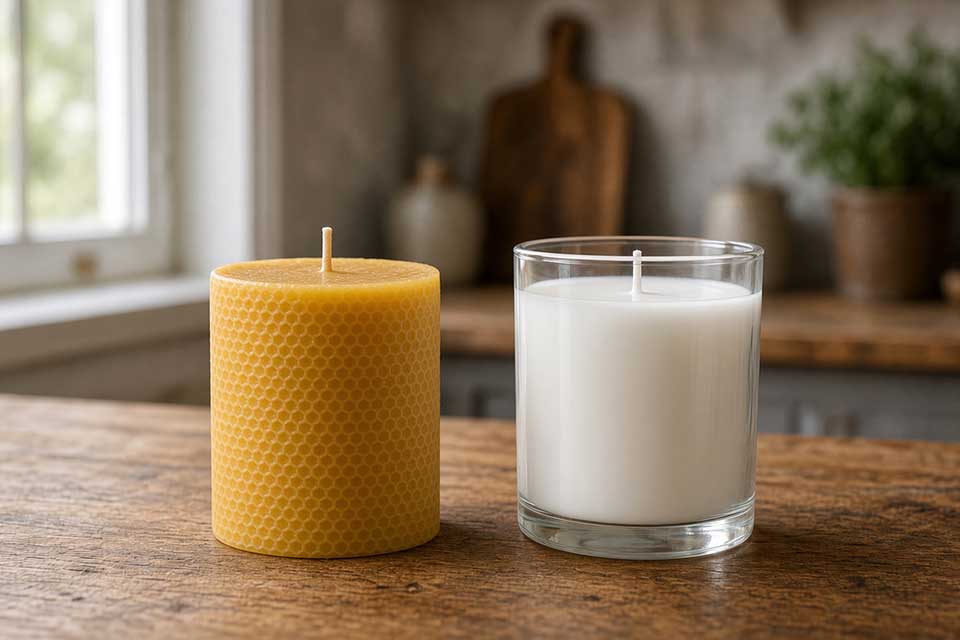
A cheap supermarket candle is usually paraffin. It lights quickly, smells of whatever oil was poured into the wax, and sits in a glass jar for £3. A beeswax candle looks quieter. It’s often gold rather than white. It costs more. And if you’ve never burned one, you may wonder whether the extra money is just beekeeper romance. It isn’t. Beeswax candles are made from the wax honeybees secrete to build comb. A proper one is wax and a wick. That’s the whole list. Paraffin is a petroleum product. The two materials burn differently, smell differently and come from completely different places.
This guide explains what beeswax candles actually are, why they behave the way they do, how to read a label that says “beeswax” when it isn’t the whole story, and when a beeswax candle is worth choosing. If you want one made from hive wax rather than a factory blend, our handmade beeswax candles are poured here in Nottingham.
What is a beeswax candle?
A beeswax candle is a candle whose fuel is beeswax: the natural wax worker bees produce from glands on their abdomen and chew into honeycomb. In the hive that wax is architecture. It holds honey, pollen and brood. When a beekeeper harvests honey, the cappings and spare comb can be melted, cleaned and poured around a wick. The result is a candle that still smells faintly of honey and the flowers the bees worked. That’s the simple version.
A 100% beeswax candle should contain beeswax and a wick. No paraffin. No soy filler. No perfume oil pretending to be “honey scent”. The smell, if there is one, comes from the wax itself. A candle labelled only “beeswax”, “beeswax blend” or “made with beeswax” is a different product. We’ll come back to that, because it’s where a lot of shoppers get caught.
Where beeswax comes from
Bees don’t make wax for us. They make it for themselves. Young worker bees eat honey and convert part of that energy into tiny wax flakes. Those flakes are chewed and shaped into comb. It takes a great deal of honey to produce a small amount of wax, which is one reason genuine beeswax is never cheap. You are not paying for a marketing story. You are paying for a scarce hive material.
The colour is not a dye chart. Fresh wax is paler. Wax that has lived in the hive longer, or picked up more pollen and propolis, runs from gold to deeper amber. Two candles from two seasons will not match like supermarket stock. That variation is normal.
We use wax from our own work around Nottinghamshire and Derbyshire. The same landscape that flavours the honey flavours the wax in a quieter way. If you want the honey side of that story, start with What Is Local Honey?.
Why beeswax candles burn differently
Beeswax is denser than paraffin and melts at a higher temperature. In practice that means three things you notice at home.
- It burns more slowly. A well-made beeswax candle often lasts longer than a paraffin candle of the same size. You pay more at the till. You don’t always use it up faster.
- The flame is warmer in colour. People describe it as gold rather than stark white. That’s the wax, not a filter on Instagram.
- The scent is light. You should not get a room-filling bakery cloud. You get a soft honey note, stronger when the candle is first lit or just blown out. If a “beeswax” candle smells of vanilla cupcake, something else is in there.
Paraffin is refined from petroleum. It is cheap, easy to scent and easy to dye. That’s why it dominates the supermarket aisle. It is not “bad” in the cartoon sense. It is a different material with a different job. If you want a loud fragrance oil and a low price, paraffin will win. If you want a simple, natural wax from a hive, it won’t.
Beeswax vs paraffin at a glance
| Beeswax candle | Typical paraffin candle | |
|---|---|---|
| Where the wax comes from | Honeybees, as comb | Petroleum refining |
| Usual ingredients | Beeswax + wick | Paraffin + fragrance + dye |
| Scent | Light, natural honey note | Added perfume oil |
| Burn | Slower, denser wax | Faster, cheaper wax |
| Colour | Natural gold to amber | Whatever the dye is |
| Price | Higher | Lower |
| Best for | Clean, quiet light and gifting | Strong scent on a budget |
Soy sits between the two for many shoppers: plant-based, often cheaper than beeswax, usually fragranced. We’ll give soy its own comparison in a later article. For this piece the useful contrast is hive wax versus supermarket paraffin.
“Beeswax candle” on the label is not a promise
This is the bit worth reading twice. In everyday retail language, “beeswax candle” does not always mean the candle is only beeswax. A maker can mix a little beeswax into a cheaper wax and still lean on the word. “Made with beeswax” is the giveaway. So is a price that looks like a multipack from the supermarket.
If you want the real thing, look for 100% beeswax or pure beeswax, written plainly. Then look at the price. Genuine wax is limited. A candle that costs the same as a scented paraffin pillar is rarely the same product.
Ask where the wax came from. A beekeeper who melts their own cappings can tell you. A brand that only says “natural wax blend” often can’t.
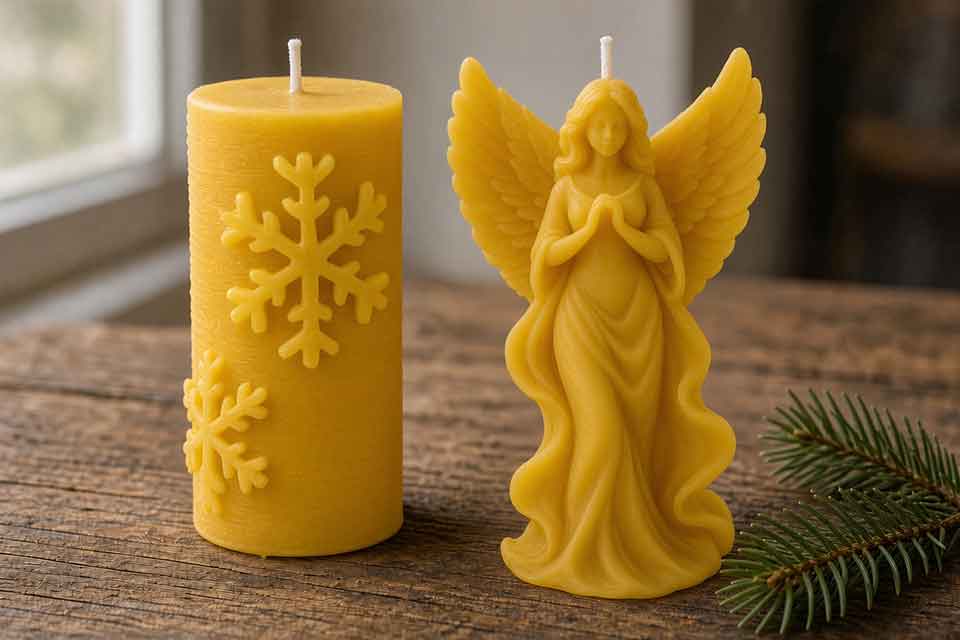
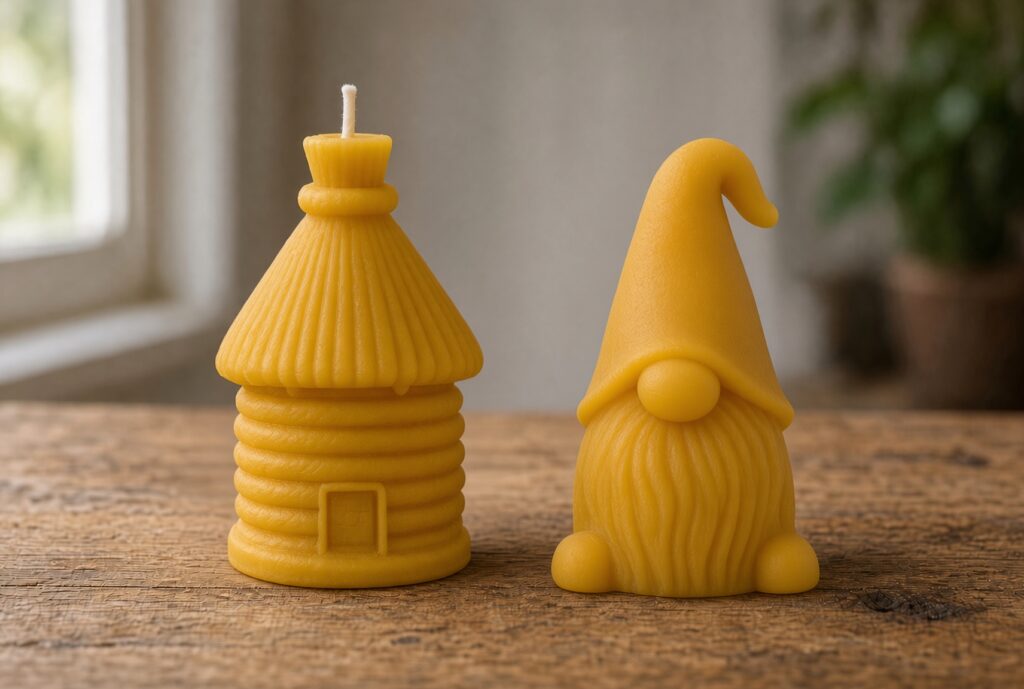
Our Beehive Beeswax Candle is made from 100% pure beeswax in our Nottingham workshop. The same goes for the figure candles — Snowflake, Pumpkin, Gnome and Angel. They are decorative first. They still burn as beeswax.
Why beeswax candles cost more
Three reasons, none of them mysterious.
- First, the bees. Wax is expensive for the colony to produce. A hive that spends energy on wax has spent energy it could have stored as honey.
- Second, cleaning. Raw comb is not a candle. It needs melting and straining so the wick burns instead of sputtering on debris. That takes time. It does not take a factory perfume lab.
- Third, scale. Paraffin is an industrial commodity. Beeswax from a small apiary is not. You are buying a by-product of real hives, not a tanker of refined wax.
If a beeswax candle is priced like a disposable tea light, be suspicious. If it is priced like a handmade object from a beekeeper, that is usually the honest number.
Do beeswax candles clean the air?
In apitherapy you will often read that a beeswax candle “cleans” a room and that the flame is kinder if you are sensitive to dust or strong perfume. Beekeepers have said versions of that for a long time. What you will not find is a large, independent study that settles it. Those trials cost serious money. A small apiary cannot pay for them. A big paraffin brand has little reason to fund work that might make its cheapest candles look worse.
So we do not hang the sale on a medical claim. We hang it on what we can stand behind. The wax comes from the hive. There is no perfume oil and no paraffin. The light is warm and the scent is a quiet honey note. That is the candle we make, and that is the candle we sell.
How to choose a beeswax candle you’ll actually use
Think about the job.
A figure candle — gnome, angel, snowflake, beehive — is partly decoration. People buy them as gifts and as table pieces. Many sit unlit for a season. That’s fine. Light them when you want the wax to earn its keep.
A simple pillar or beehive shape is easier to burn as a candle rather than as an ornament.
A scented jar from the supermarket is a different purchase. Don’t compare them as if they were the same object.
If you are buying for Christmas, start with the winter shapes: snowflake, stars, sleeping angel or the pumpkin if you are still in autumn. A later article will cover Christmas gifting properly. For now, the rule is the same: buy 100% beeswax, not a blend with a festive label.
Pair a candle with a jar of honey if you are sending a present. The honey collection is here: raw local honey. Set jars, if that’s the texture you like, are in set honey.
A word on safety
Any candle is a flame. Never leave one burning unattended. Keep it away from curtains, children and pets. Stand figures on a heat-safe dish, because beeswax can pool. Trim a long wick before you light it. Don’t burn a candle in a draught if you can help it — that’s how you get smoke and a crooked melt. The UK Fire and Rescue services repeat the same advice every winter because people ignore it. A pretty gnome is still a candle.
Beeswax candles from Buzzy Honey Bee
We are beekeepers first. The wax is not a side hustle invented for a trend. It comes from the same work as the honey: village apiaries, cappings, clean wax, a wick.
You’ll find:
- Beehive Beeswax Candle — the straightforward hive shape
- Gnome and Honey Gnome
- Angel and Sleeping Angel
- Snowflake and Stars
- Pumpkin and Small Pumpkin
- Teddy Bear with Hat
They are handmade. Small differences in colour are the wax, not a fault. If you came for honey and stayed for the candle, that’s the right way round.
Frequently asked questions
What are beeswax candles made of?
A 100% beeswax candle is beeswax and a wick. Nothing else needs to be in there. If the label lists fragrance oils, paraffin or “wax blend”, you are not buying a pure beeswax candle.
Why choose beeswax over paraffin?
Choose beeswax if you want a natural hive wax, a slower burn and a light honey scent without perfume. Choose paraffin if you want a strong added fragrance and a lower price. They are different products.
Do beeswax candles drip?
They can. Dense wax and a steady flame help, but a draught, a long wick or a figure with an awkward shape will still make a pool. Use a dish.
Why is my beeswax candle going white and dusty?
That’s often bloom: a natural film on the surface of beeswax. It is not mould. You can leave it or buff it gently. A later storage article will cover this in more detail.
Are beeswax candles scented?
Pure ones are only as scented as the wax. The note is honey, not “Honey Vanilla Frosting”. Strong room-filling smell usually means added fragrance.
Are beeswax candles better for you?
They are a simpler ingredient list than many scented paraffin jars. That is not the same as a health claim. Don’t burn any candle as medicine.
Can I give beeswax candles as a Christmas present?
Yes. The winter figures are made for that. Add a jar of local honey if you want a present that looks like it came from an apiary rather than a warehouse.
Do you make the candles yourself?
Yes. They are made in our Nottingham workshop from beeswax, not bought in as anonymous “bee-themed” paraffin.
A last word
A beeswax candle is not a supermarket pillar with a nicer story. It is hive wax on a wick. That’s why it costs more, why it smells quieter and why the colour doesn’t match from batch to batch. If that is what you want, ignore the word “beeswax” on a cheap blend and look for 100%. Then light it on a dish, keep an eye on it, and let the wax do the simple job it has done for a very long time.
Browse the candles, or start with the Beehive Beeswax Candle. If you’d rather eat the hive than burn it, the raw local honey is this way.
Enjoyed this article? If you’d like to support more honest writing about bees and local honey, you can buy me a coffee here:
Buy Me a Coffee – Buzzy Honey Bee
Your support also helps me continue working with the bees and offering free bee swarm collection.
Of course, the best way to support this small apiary is still by choosing one of the products below.